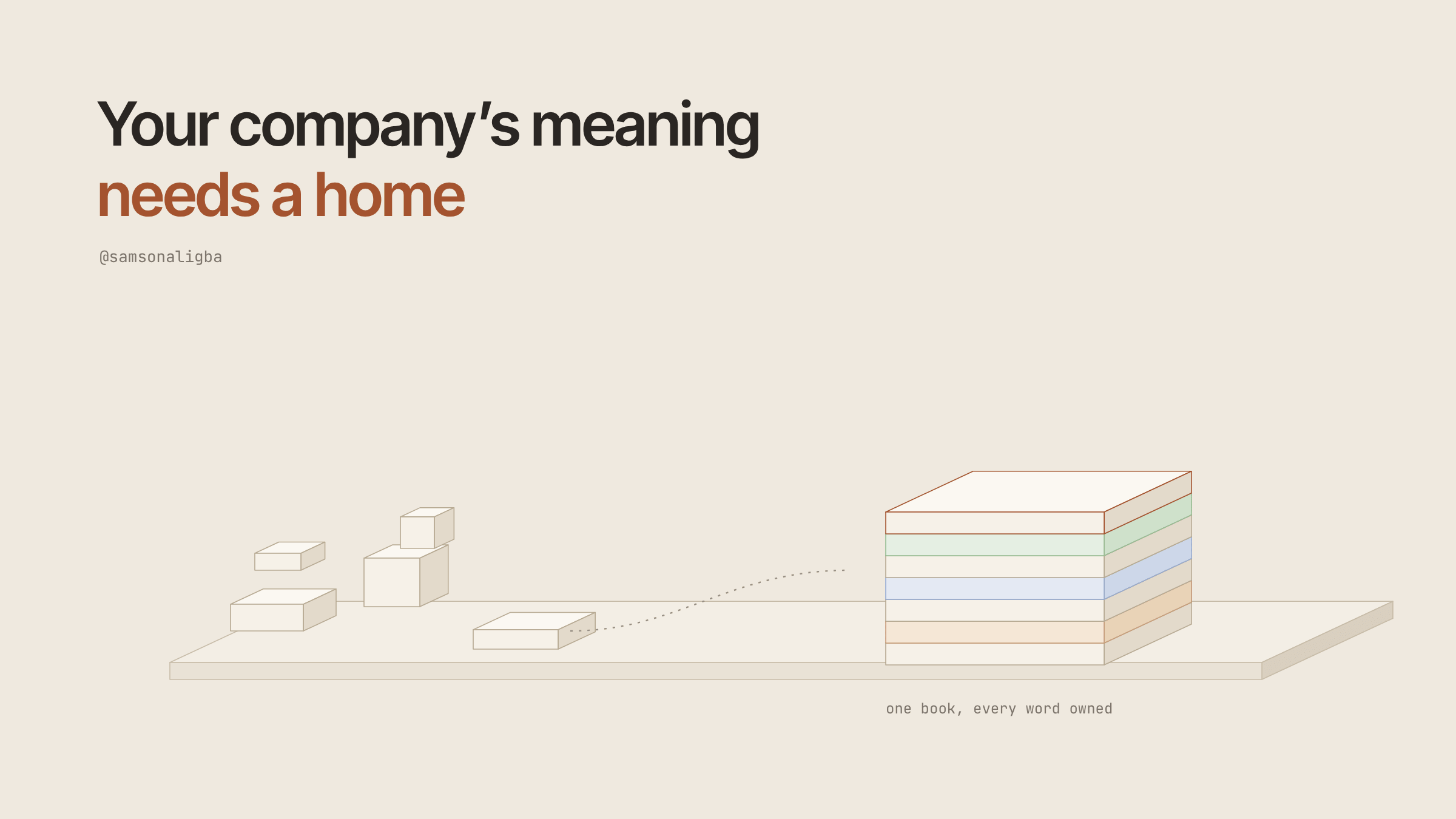
Your company's meaning needs a home
Most companies aren't ready to let AI make decisions for them, and the models aren't the reason. The company itself has never written down what it means.
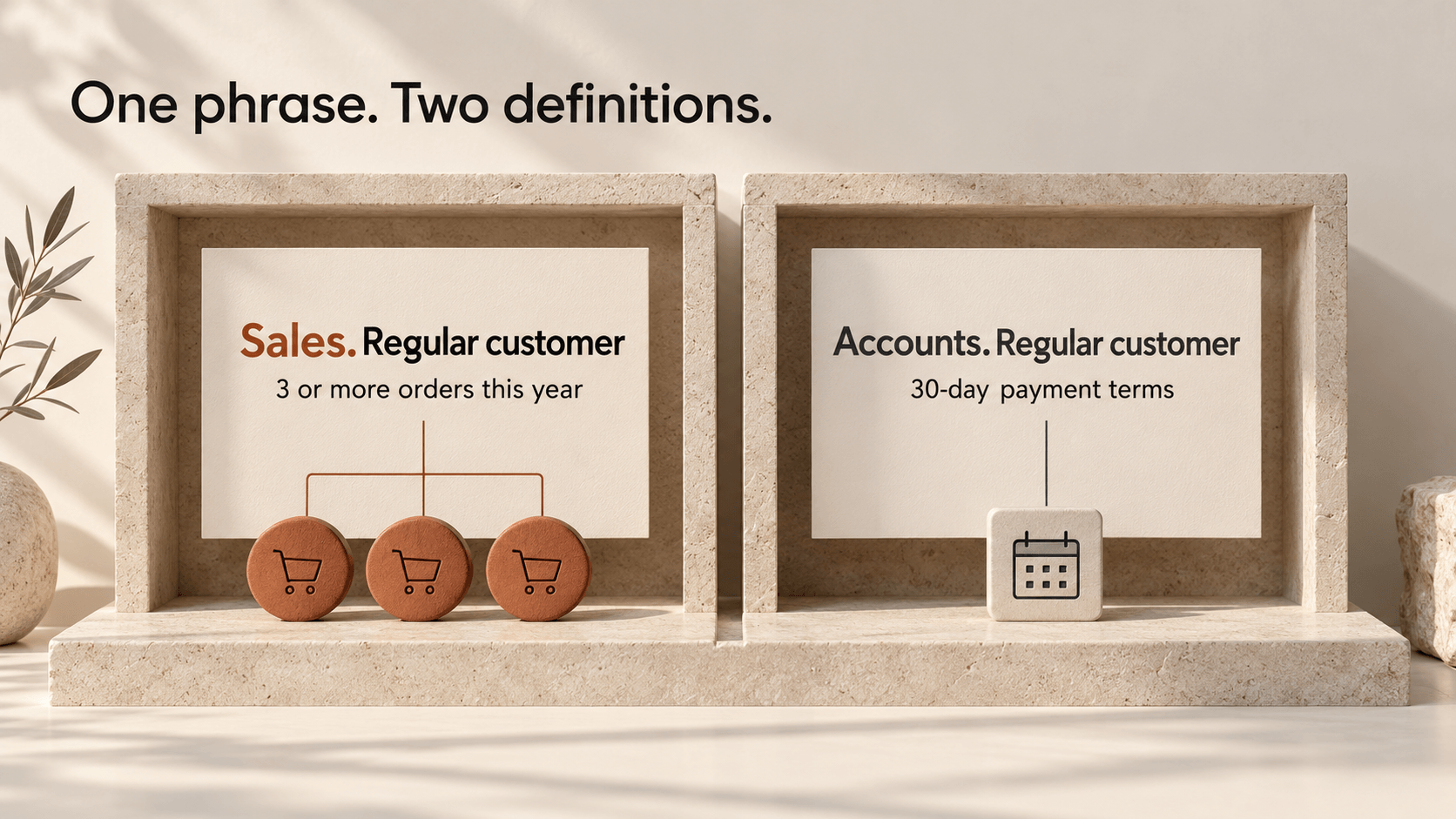
Ask what counts as an active customer. Finance gives you one answer, the product team gives you another, and whoever built the dashboard has a third. The real definition is spread across a glossary nobody updates, a policy document nobody can run, some code, and mostly the heads of people who've been around a long time. People cope with this because they ask each other. An AI agent won't ask. It will pick a meaning and act on it, with complete confidence.
I learned a version of this the hard way at Hyphen. Our customers' workflow knowledge lived in "people's heads, spreadsheets, and WhatsApp groups." When a customer's internal champion left, what they knew left with them, and our platform ended up being the only place some of it survived.
Braid is a language we're working on at fineSample, my research practice, to deal with exactly this. A business expert writes down what the company's words mean and how its decisions work, in one place, and a computer runs precisely that. The meaning belongs to the company. It isn't borrowed from a model trained on other people's language.
Meaning first, then rules
If this sounds like the expert systems of the 1980s, it should. They wrote rules down too, and they could explain their answers. They also collapsed, and the reasons matter. Knowledge engineers wrote rules the actual experts couldn't read. Everything sat in one shared pile, so nobody owned what a word meant. Hard facts and soft evidence were blended into one certainty score, and when rules clashed the engine quietly picked a winner. After a few thousand rules, nobody dared touch anything. Braid is designed around those failures, starting with the first: the people accountable for the meaning write it, in their own words.
So Braid starts with meaning. Take a small catering company, Northstar Catering. Here's part of what it means:
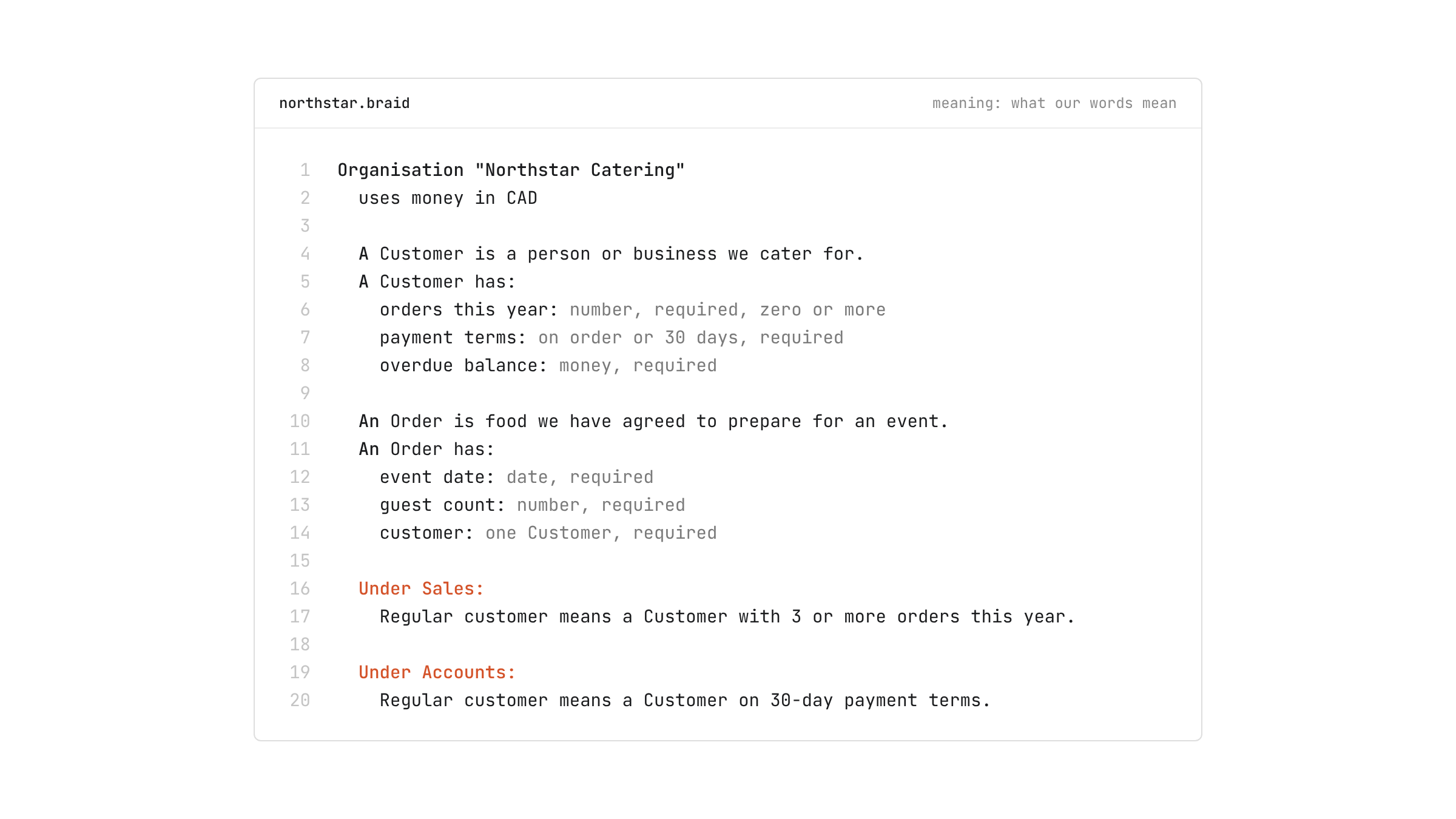
Look at the last two definitions. In a small business, whoever takes bookings and whoever chases invoices both say "regular customer" and mean different people. Nobody notices until someone gets 30-day terms they shouldn't have. Braid keeps both meanings and refuses any rule that just says "regular customer." It has to say Sales.Regular customer or Accounts.Regular customer.
Rules come second, and they can only use words that are already defined. Reach for a word nobody defined and the rule fails before anything runs. Unmesh Joshi makes a related case on Martin Fowler's site, that small, strict languages are what make systems reliable because "a DSL strips the variation away." Where the data actually lives, a spreadsheet or the booking app or the accounting software, is kept separate, so switching tools means updating one mapping, not rewriting rules.
Stop signs and stars
Most decision systems mix up rules that must hold with evidence that leans one way. Braid keeps them apart. Here's Northstar deciding whether to squeeze a short-notice order into this week:
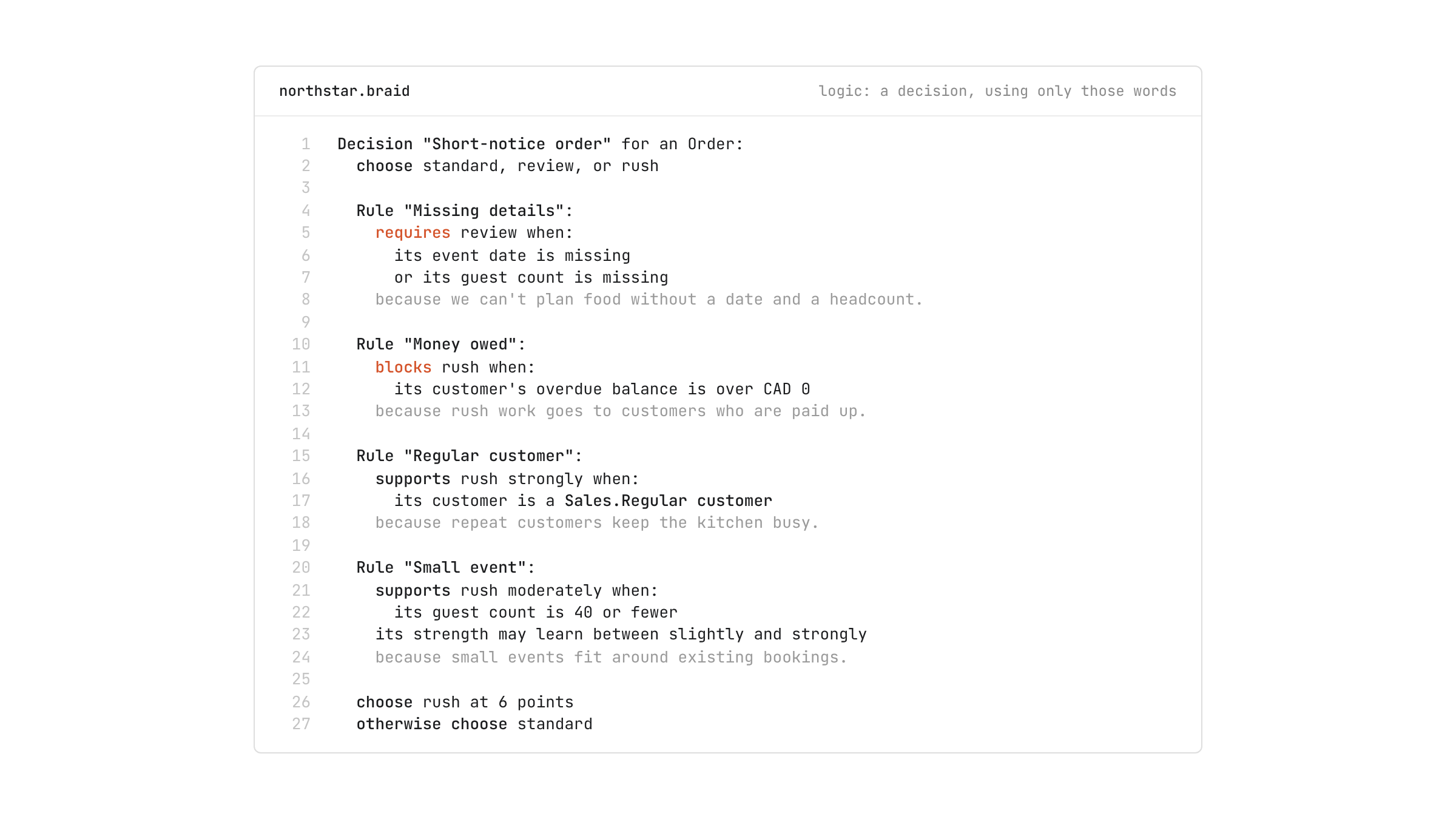
The owner can read that. So can the person they hired last week. The requires and blocks rules are stop signs. The supports rules hand out stars: strongly is worth 4, moderately 2, and rush needs 6.
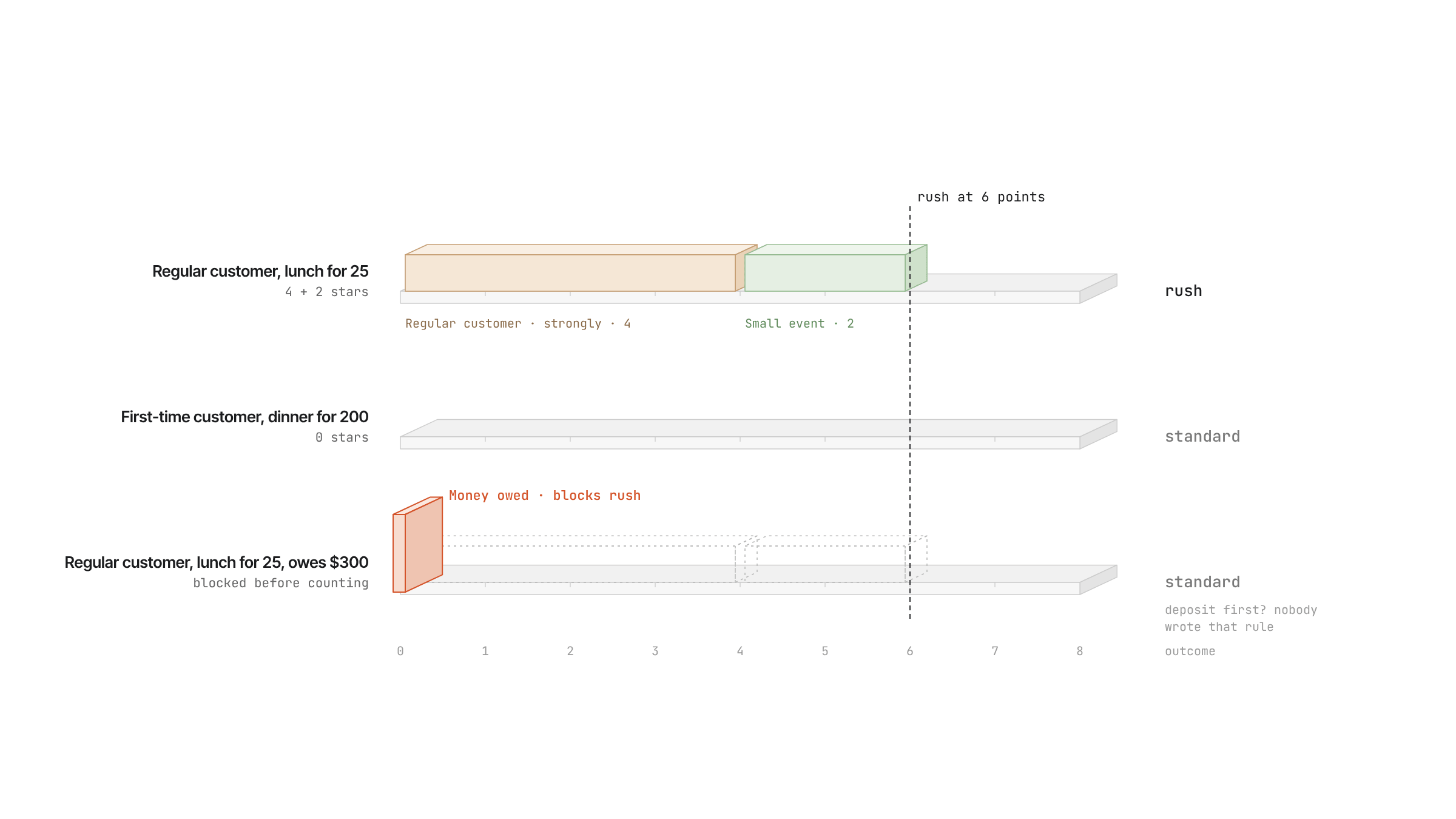
A regular customer asking for lunch for 25 on Thursday gets 4 plus 2, and the order gets rushed.
Now the case that matters. Same regular customer, same lunch for 25, six stars. But they still owe $300 from last month, so rush is removed before anyone counts. Stars never outvote a stop sign.
With rush gone and no rule asking for review, the order falls back to standard. Is that what the owner wants? Maybe they'd rather take it with a deposit up front. Nobody wrote that rule, though, so Braid won't make one up. I've come round to thinking that's the point: the gap shows up as a decision someone has to make on purpose, instead of a habit living in one person's head.
And every because travels with the answer. Ask later why an order got rushed and you get the rules that fired, the facts they used and the reasons the owner wrote down. An answer without its reason is a rumour with formatting.
What it refuses to do
It won't guess. An undefined word stops everything until someone defines it. A missing guest count isn't a small guest count, it's an unknown one, and unknowns go to a person.
It won't let learning rewrite the rules. Look at "Small event." Its strength can move between slightly and strongly as approved outcomes come in, and nothing else in that decision can move at all. Every change is logged, so a bad one can be rolled back without erasing what happened.
It won't settle arguments it wasn't given the answer to. If two stop signs contradict each other, the result comes back unresolved with both rules attached, and a person decides.
And it won't rent you your own meaning. A model trained on thousands of other companies can be very fluent and still not know which "regular customer" your bookkeeper means. What we're after is a native model, one made from the company's own meaning and owned by the people accountable for it.
None of this is quick. Writing down what a business means is real work and the first version will have holes. But each definition and each reason lands somewhere it can be kept, tested and handed on, instead of living in a group chat.
Most businesses already have someone doing this job unofficially. They're the person everyone messages when something looks off. Almost everything Braid asks you to write down is already in that person's head. It just isn't anywhere a machine can read it yet.
Samson Aligba advises executives and founders on putting AI to work in their business. Braid is part of the research at fineSample. If you're working out how AI should make decisions in your organization, get in touch.