Thank you! Your submission has been received
Samson Aligba
New White Paper — March 2026
Every organisation has people whose reasoning is disproportionately valuable. Not what they know — what they know can be documented. What makes them indispensable is how they think: the way they frame problems, decompose complexity, evaluate risk, and move from analysis to action.
That reasoning walks out of the room when they leave. No existing tool captures it. Meeting transcription captures what was said. Personality assessment captures who someone is. Topic modeling captures what was discussed. None of them capture the computational structure of cognition — the specific operations a person performs when they think through a strategic problem.
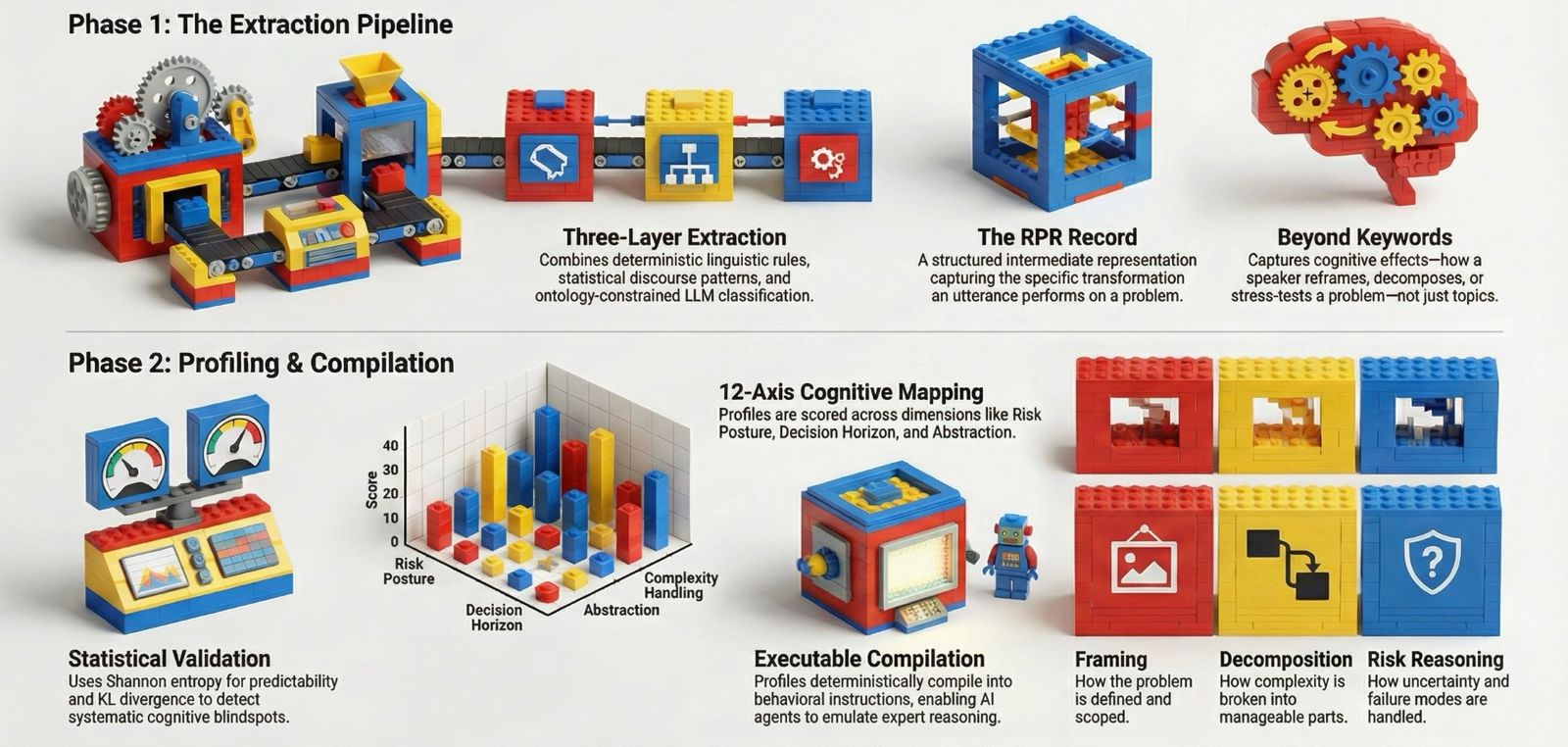
This paper introduces Reasoning Primitive Representation (RPR), a formal intermediate representation for modeling human strategic cognition from conversational discourse. RPR encodes individual reasoning events as typed transformations on an abstract problem space — not as labels, but as structured records of what changed about the problem as a result of each utterance.
The paper presents three contributions:
A controlled ontology of 40 reasoning primitives across 8 families — a formal vocabulary for strategic cognition grounded in observable discourse.
A structured intermediate representation (RPR) that enables extraction validation, aggregation, stability filtering, and deterministic compilation into executable behavior specifications.
A statistical framework employing Shannon entropy, Kullback-Leibler divergence, and Mahalanobis distance for deriving stable cognitive profiles from noisy conversational data — including blindspot detection and false persona filtering.
The resulting profiles compile into system prompts that cause an AI to reason like a specific person — not to sound like them, but to frame problems, decompose complexity, and evaluate tradeoffs the way they do. The profile is auditable, evidence-grounded, and deterministic: the same profile always produces the same prompt.
This paper presents the theoretical framework. Empirical validation against real meeting transcripts will be reported in subsequent work.